
Basketball Positions Explained: Point Guard to Centre
- November 24, 2026
Point guard, small forward, “the five”… Here are the basketball positions explained in plain English, for players, parents and new fans.
Tap the court to meet each position and what it does, flip the cards to learn the newer position names, find a position that might suit you, then try the 10-question quiz.
- Positions 5
- Court Tap to explore
- Finder 5 questions
- Quiz 10 questions
What are basketball positions?
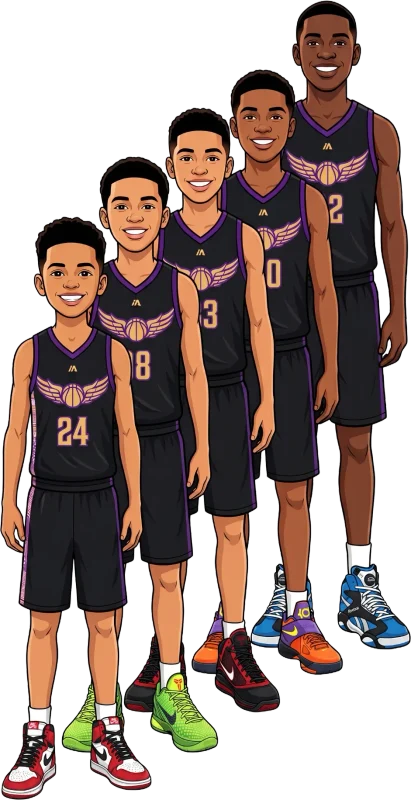
A basketball team has five players on the court at a time. Each player has a position: a usual area of the court and a main job. Coaches often call the positions by number, from 1 to 5.
The positions are a guide, not a rule. Every player still dribbles, passes, shoots, rebounds and defends. The ball also moves quickly, so players swap spots all through a game.
- Point guard
- Shooting guard
- Small forward
- Power forward
- Centre
The five basketball positions
Tap a number to see where each position plays, its main jobs and the skills to practise.
Tap a number on the court or a button above.
- 1
Point guard
“The one”
Where: Brings the ball up the court and usually starts the play from the top of the key.
Main jobs
- Bring the ball up the court, even under pressure
- Start the team’s plays and call the ones the coach gives
- Get the ball to teammates in good spots to score
- Talk, organise and keep the team calm
Key skills
- Ball-handling with both hands
- Passing
- Seeing the whole court
- Quick decisions
- Talking
On defence: Pressures the other team’s ball handler, and is often the first player back to stop a fast break.
Might suit a player who loves having the ball, enjoys setting up teammates and stays calm when things get busy.
Practise with: Right-Left Pound, Cone Weaving and Control and the pick-and-roll drill.
- 2
Shooting guard
“The two”
Where: Usually starts on a wing, and moves between the wings and the corners.
Main jobs
- Score from outside and by driving to the basket
- Keep moving without the ball to get open
- Help the point guard bring the ball up
- Run the floor on the fast break
Key skills
- Shooting
- Moving without the ball
- Catch-and-shoot footwork
- Driving past a closeout
On defence: Often guards the other team’s best outside shooter and chases them around screens.
Might suit a player who loves shooting, is quick on their feet and likes to keep moving.
Practise with: Spot Shooting with Game Movement and the 2-on-2 closeout drill.
- 3
Small forward
“The three”
Where: Plays on the wing and in the corner, and cuts to the basket.
Main jobs
- Score in lots of ways: shooting, driving and cutting
- Help on the rebound at both ends
- Fill a lane on the fast break
- Defend both bigger and smaller players
Key skills
- All-round skills
- Cutting to the basket
- Finishing with both hands
- Rebounding
On defence: Often guards the other team’s best wing player and helps teammates near the basket.
Might suit a player who likes doing a bit of everything and enjoys the challenge of guarding different players.
Practise with: the 3-on-2 fast break drill and the Mikan Drill.
- 4
Power forward
“The four”
Where: Plays around the elbows, the short corner and the low post. Some fours also step out to the three-point line.
Main jobs
- Rebound at both ends of the court
- Set screens to free up teammates
- Score close to the basket and from mid-range
- Box out on every shot
Key skills
- Rebounding
- Setting screens
- Footwork near the basket
- Mid-range shooting
On defence: Guards a forward, helps protect the basket and boxes out to finish the defensive play with a rebound.
Might suit a player who loves to compete for the ball, doesn’t mind contact and likes doing the work that wins games.
Practise with: the 3-point box-out drill and the pick-and-roll drill.
- 5
Centre
“The five”, or a “big”
Where: Plays in and around the key, close to the basket.
Main jobs
- Rebound and protect the basket
- Score close in with post moves and layups
- Set screens and roll to the basket
- Talk on defence: the centre can see the whole play
Key skills
- Footwork
- Catching with two hands
- Finishing with both hands
- Timing for blocks and rebounds
On defence: Protects the basket by blocking or changing shots without fouling, and calls out screens to teammates.
Might suit a player who is calm, strong, hard to get past and enjoys being the last line of defence.
Practise with: the Mikan Drill, the 3-point box-out drill and the shell drill.
Guards, forwards and bigs
You’ll often hear players grouped into three families.
1 and 2
Guards
The ball handlers and outside shooters. Guards bring the ball up, run the plays and are often the quickest players on the court.
3 and 4
Forwards
The all-rounders. Forwards play on the wings and around the key, score in different ways and help on the rebound.
5, and often the 4
Bigs
The players closest to the basket. Bigs rebound, set screens, protect the rim and finish close in.
Other position names you might hear
Newer position names you might hear at games and on TV. Tap a card to see what it means.
Find your position
Five quick questions, just for fun. Pick the answer that sounds most like you.
You might enjoy playing
Point guard
You like to lead and to make your teammates better. Work on ball-handling with both hands and on seeing the whole court.
You might enjoy playing
Shooting guard or small forward
You love to score and to keep moving. Work on your shooting and on getting open without the ball.
You might enjoy playing
Power forward
You love to compete for every ball. Work on boxing out, setting screens and finishing close to the basket.
You might enjoy playing
Centre
You like being the anchor at both ends. Work on your footwork, catching with two hands and finishing with either hand.
Just for fun: the best players can play more than one position, so try them all. Your coach will help you find where you fit in the team.
The position finder needs JavaScript. In short: if you love dribbling and setting up teammates, try point guard; shooting and moving, try the wing; rebounding and screens, try power forward; protecting the basket, try centre.
Positions in junior basketball
In junior basketball, a position is a starting point, not a label. Many coaches move players around so that everyone learns to dribble, pass, shoot, rebound and defend. That’s a good thing. Players grow and change, and the skills of every position make them better at all of them.
- Ask the coach what your child’s role is this season, and cheer the jobs that don’t show on the scoresheet: a screen, a box-out, a great pass.
- Height isn’t everything. A shorter player can be a great rebounder, and a tall player still needs to dribble and pass.
- Practise every skill at home: ball-handling with both hands, shooting, and layups on both sides of the basket.
- Learn the words. Our basketball terminology guide explains the court, the rules and what the coach is shouting.
Basketball positions quiz
10 questions on the basketball positions. Every right answer drops a ball through the net.
Basketball positions FAQ
What are the 5 positions in basketball?
Point guard (1), shooting guard (2), small forward (3), power forward (4) and centre (5). The 1 and 2 are the guards, the 3 and 4 are the forwards, and the 5 (often with the 4) are the bigs.
What position is number 3 in basketball?
Number 3 is the small forward: an all-rounder who plays on the wing and in the corner, and shoots, drives, cuts, rebounds and defends.
Which basketball position is the most important?
None of them on its own. A team needs all five working together: someone to run the play, players to score, and players to rebound and protect the basket.
Does height decide your basketball position?
Not on its own. Taller players often play closer to the basket, but skills, speed, decisions and effort matter just as much, especially in junior basketball, where players are still growing.
What position should my child play?
Let them try them all. Many junior coaches move players between positions so everyone learns every skill. The coach will help your child find where they fit in the team.
What is a “big” in basketball?
A nickname for the tall players who play near the basket, usually the power forward (4) and the centre (5). See our basketball terminology guide for more words you’ll hear at games.
Ready to find your position?
The best way to learn the positions is to play them. Join a Saints team, or brush up on the words the coach uses.
Join the Saints
Girls and boys teams from U10 to U19, playing in the Northern Districts Basketball Association.
Free weekly email
Get The Saturday Wrap
Every Saints result, top scorer and story from Saturday, in your inbox the moment the weekly wrap is published.
Free, every Saturday. Unsubscribe any time. We only use your email for The Saturday Wrap. Privacy policy
A community-focused basketball club in North Brisbane and a proud member of the NDBA.
Proud partners



© 2026 North West Saints Basketball Club