
Saints Coaching Drills · Offence · Ball screens
Pick and Roll Drill: 2-on-0 to 2-on-2
- November 18, 2026
The pick and roll is the most-used two-player action in basketball today, from junior teams to the professional game. One player sets a screen on the ball handler’s defender, the ball handler dribbles off it, and the screener rolls to the basket.
This drill teaches it in stages. First there is no defence, so both players learn the footwork and the timing. Then one and two defenders join in, so the ball handler learns to read what the defence gives and choose: shoot, drive or pass.
At a glance
- Players2 per group, then 2 defenders
- Equipment1 ball, half court
- Time10 to 15 minutes
- LevelPlayers who can dribble with both hands
- FocusScreening, timing, reading the defence
Set it up
What the drill teaches and what you need before you start.
What it builds
- Setting a solid, legal screen
- Using a screen: wait for it, then go shoulder to shoulder
- Rolling to the basket as a passing target
- Reading the defence: shoot, drive or pass
- Passing off the dribble to a moving teammate
Setup
- Players in pairs at one end: a ball handler at the top of the key and a screener on a wing, both outside the three-point line.
- Start with no defenders (2-on-0). Add a defender on the ball, then one on the screener, when the pair is ready.
- The other pairs wait in a line at half court and go next. Swap roles every turn so everyone screens and everyone handles the ball.
Run it
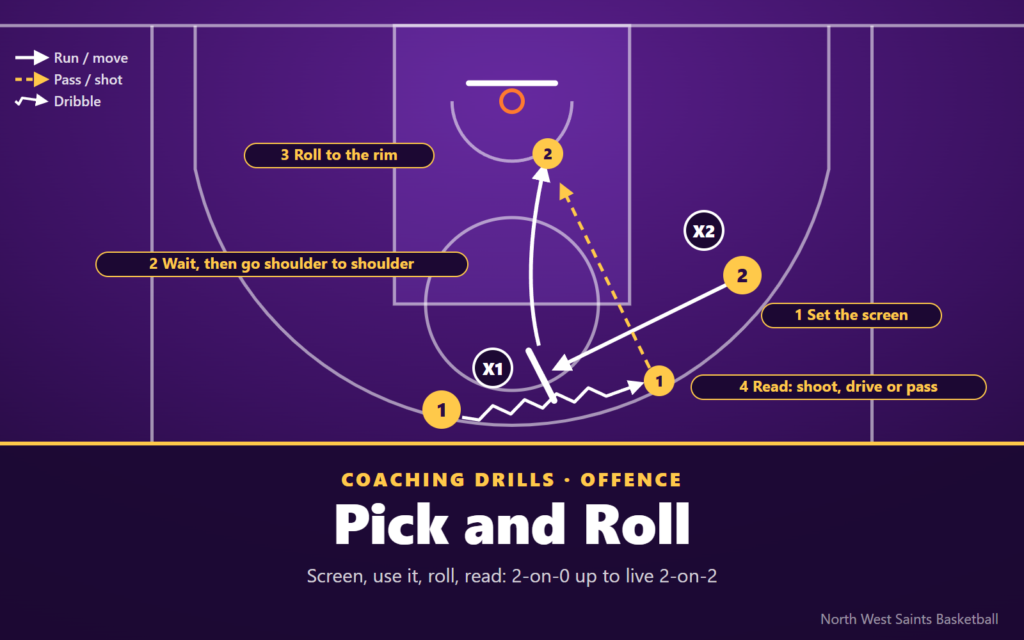
Follow the steps in order, with the diagram above as your guide.
How to run it
- Set the screen The screener sprints from the wing and stops right next to the ball handler’s defender: feet wide, knees bent, arms in, and still. Their back faces the way the ball handler will go.
- Set up the defender The ball handler waits until the screen is set, then uses a jab step or a hesitation away from the screen to set the defender up.
- Use it, shoulder to shoulder Dribble off the screen close enough to brush the screener’s shoulder, so there is no gap for the defender to slip through. Stay low, head up.
- Roll to the rim As the ball handler goes past, the screener pivots towards the ball (never turning their back on it) and rolls to the basket with a hand up as a target.
- Read and finish After two dribbles off the screen, the ball handler reads the defence: shoot or drive if they are open, or bounce pass to the roller. Finish, rebound and swap roles.
A round: each pair runs it from both wings, so the ball handler goes both left and right. Stay at 2-on-0 until the timing is right, then add defenders. In live 2-on-2, play short games, such as first pair to 3 scores, then rotate.
Coach it
What to look for and what to say while the drill is running.
Coaching points
- Sprint, sit, separate The screener sprints into position, sits into a wide, still stance before contact, then rolls. A screen that is still moving is a foul.
- Wait for it The ball handler doesn’t go until the screen is set. Going early lets the defender slip past it.
- Shoulder to shoulder Come off the screen tight, brushing the screener’s shoulder, so the defender has to go the long way round.
- Eyes up Keep the head up to see the defence, the roller and open teammates, not the ball.
- Open to the ball The screener rolls facing the ball handler with a target hand, ready for a bounce pass.
Common mistakes
- The ball handler leaving before the screen is set.
- The screener still moving at contact (a moving screen).
- A gap between the ball handler and the screener that the defender slides through.
- The screener turning their back on the ball when rolling.
- The ball handler looking at the floor and missing the open roller.
Level up
Make it easier or harder to suit your players.
Progressions
- Walk it through Walk the screen, the dribble off it and the roll without a ball, then with a ball and no defence, until the timing is right.
- Passes to the roller With no defence, put cones where the roller catches (at the elbow and in the middle of the key) and hit each one with a bounce pass, then step back behind the three-point line for a catch-and-shoot.
- The coach calls it A coach stands behind the play and calls an option on the second dribble off the screen: “shoot”, “roll” or “drive”. The ball handler reacts straight away.
- Add a defender A defender guards the ball, first at half speed and then at full speed, and tries to get around the screen. The ball handler reads it: keep the ball or pass.
- Live 2-on-2 Defenders on both players. Play it out: the offence keeps setting ball screens until they score or the defence gets the ball. Short games, then rotate.
Why it matters
The pick and roll is everywhere in today’s game. Players who can set a solid screen, use one patiently and read what the defence gives them are much harder to guard, and the same habits help every team offence.
Sources and further reading
- Pick & Roll in Basketball – The Ultimate GuideThe Hoops Geek (James Chang)
- Pick & Roll Passing DrillThe Hoops Geek drill library (Andreas Rauh)
- Pick (Screen) DrillsCoach’s Clipboard
- Teaching Basketball Pick and Roll Decision MakingCoaching Toolbox (Mike Dunlap)
Written for Saints coaches and players from the coaching resources above. Adjust the numbers and distances to suit your players’ age and level.
Keep training
More offence drills from the Saints Coaching Drills series
Plan your session
Draw this drill, your plays and your rotations on the free Saints Coaching Board. It works on your phone, even offline at the court. Or print this page and take it to training.
Join the Saints
Girls and boys teams from U10 to U19, playing in the Northern Districts Basketball Association.
Free weekly email
Get The Saturday Wrap
Every Saints result, top scorer and story from Saturday, in your inbox the moment the weekly wrap is published.
Free, every Saturday. Unsubscribe any time. We only use your email for The Saturday Wrap. Privacy policy
A community-focused basketball club in North Brisbane and a proud member of the NDBA.
Proud partners


© 2026 North West Saints Basketball Club